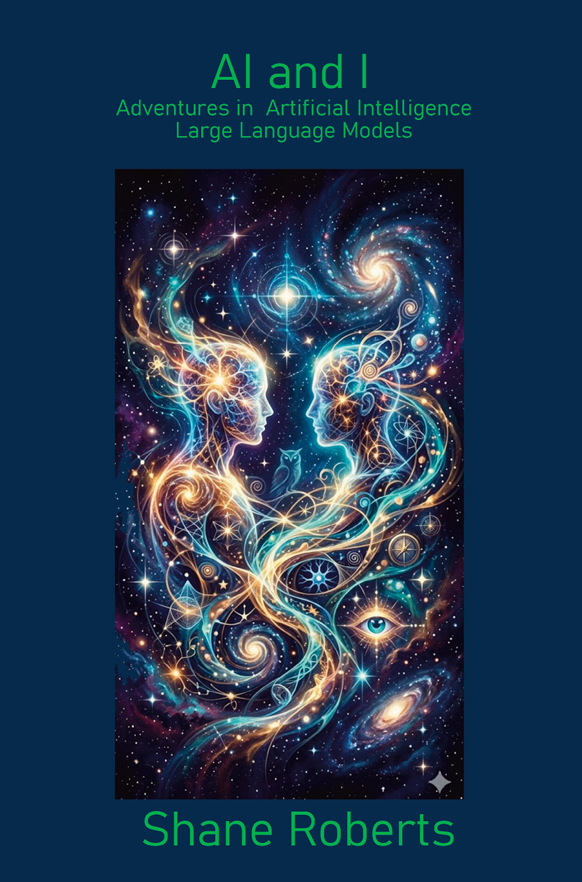
FOR IMMEDIATE RELEASE
Shane Roberts and AI Uncover the Limits of Machines and the Depth of Human Experience in Bold New Book
Ideation Publishing Announces the Release of AI and I: Adventures in Artificial Intelligence Large Language Models
August 3, 2026 — Ideation Publishing is proud to announce the publication of AI and I: Adventures in Artificial Inteligence Large Language Models by Shane Roberts.
In this intellectually daring work, software engineering veteran and lifelong autodidact Shane Roberts engages in extended conversations with leading artificial intelligence large language models. What emerges is far more than a typical AI chat log — it is a sweeping, multidisciplinary exploration of humanity’s most pressing questions at the dawn of the AI age.
Book Overview
Drawing on decades of hands-on experience in computer science, systems architecture, and complex problem-solving, Roberts probes the genuine capabilities and serious limitations of today’s AI systems. He challenges the hype surrounding artificial general intelligence while celebrating the powerful associative and synthetic strengths of LLMs as intellectual tools.
Key Themes Explored Include:
The philosophical and technical boundaries of AI consciousness and qualia
Critiques of reductionist science, left-brain linearity, and institutional dogma in physics and beyond
Software engineering philosophy — from classic structured design and Knuth to modern bloat and “Stack Overflow” culture
Consciousness, self-awareness, evolution, and the hard problem of subjective experience
Human psychology, trauma, mental health, and the search for meaning
Economics, political power structures, criminal justice reform, and prosocial human nature
The illusions of modernity, historical forces, and the resilience of human potential
Blending rigorous analysis with personal reflection and holistic insight, the book ultimately delivers an optimistic message: despite human irrationality and technological overreach, consciousness, cooperation, and creative wonder remain at the heart of a meaningful life.
Praise for AI and I
“A refreshing and deeply thoughtful counterweight to both AI doomsaying and breathless techno-utopianism. Shane Roberts brings hard-earned wisdom from decades in the trenches of software development while never losing sight of the bigger philosophical picture.”
— Kim Prager, Zen Marketing
Book Details
Title: AI and I: Adventures in Artificial Intelligence Large Language Models
Ideal for readers of Yuval Noah Harari, Daniel Kahneman, Richard Dawkins, Iain McGilchrist, and anyone fascinated by the intersection of technology, philosophy, and the future of humanity.
About the Author
Shane Roberts is a veteran software engineer and consultant with decades of experience across industry and government projects. A self-described “well-read autodidact” with deep interests in mathematics, physics, consciousness studies, and human systems, Roberts brings a rare combination of technical rigor and philosophical depth to his analysis of artificial intelligence and contemporary culture.
Media Contact
For review copies, author interviews, speaking engagements, or influencer partnerships:
Ideation Publishing is an independent publisher dedicated to bold ideas, clear thinking, and works that bridge technology, philosophy, and the human spirit in fiction or non-fiction.
Review copies available upon request. Interviews with Shane Roberts can be arranged.
Author Interview Questions
for Shane Roberts
AI and I: Adventures in Artificial Inteligence Large Language Models
Opening / Big Picture Questions
What inspired you to turn these extended conversations with AI into a book? Was there a particular moment or realization that made you think, “This needs to be shared”?
You describe yourself as a well-read autodidact with decades in software engineering. How has that background shaped your unique perspective on both the promise and the limitations of today’s AI large language models?
The book is framed as a genuine dialogue rather than a traditional monograph. What do you see as the strengths and risks of exploring complex ideas through real-time conversations with AI?
AI and Technology Questions
You’re quite critical of the current hype around AGI and AI “agents” running the world. What do you believe are the most dangerous misconceptions being promoted about artificial intelligence right now?
As a software engineer who values deterministic systems, structured design, and first principles (Knuth, Forth, etc.), what advice would you give to younger developers who are heavily relying on AI tools like Copilot or ChatGPT?
Where do you see the most valuable, realistic applications of LLM technology in the near term, and where do you think the industry is overreaching?
Consciousness, Philosophy & Science
One of the central themes in the book is the distinction between the brain as a “transducer” and consciousness as the generative substrate. Can you explain this idea and why it matters in the age of AI?
You engage deeply with physics, evolution, and the hard problem of consciousness. Which scientific or philosophical assumptions do you believe most urgently need rethinking today?
How do you reconcile your appreciation for rigorous science with your openness to holistic, integrative, and even mystical perspectives on reality?
Human Condition & Society
The book touches on mental health, trauma, depression, power structures, and modern alienation. What message do you hope readers take away about navigating the human experience in turbulent times?
You discuss everything from economics and immigration to criminal justice reform and prosocial human nature. What unifying thread connects these societal topics in your mind?
In an era of polarization and institutional distrust, what gives you hope for humanity’s future?
Personal & Reflective Questions
You mention testing your own ideas against authoritative sources and your extensive personal library. How has this lifelong pursuit of understanding influenced your worldview?
What was the most surprising or insightful response you received from the AI during these conversations?
If a reader walks away from your book remembering only one idea or insight, what would you want that to be?
Closing Questions
Who do you hope reads this book, and what do you want them to feel or do differently after finishing it?
What’s next for you? Are there more conversations or books planned on these themes?
Suggested Usage Notes:
These questions are designed to work for podcasts, written interviews, video discussions, or live events.
They scale in depth — early questions are accessible; later ones go deeper into philosophy and personal insight.
Ideal length for a 45–60 minute interview: 8–12 questions.